Company Commander AI
Company Commander AI is the advanced “headless” edition of Hexwar’s flagship tactical PME platform…


Littoral Commander is Hexwar’s operational-level PME wargame for the contested maritime-littoral environment the operational domain where naval surface power, land manoeuvre, amphibious capability, air power, and emerging technologies intersect under conditions of sustained adversary contestation.
Designed by Sebastian Bae and transferred digitally by Hexwar Games through rigorous unclassified research, it addresses the fundamental operational design challenge of near-future conflict: how do joint forces generate, project, and sustain combat power in a distributed, A2/AD-constrained environment against a peer adversary with the capability and will to contest every domain simultaneously? Scenarios are set in the Indo-Pacific (South China Sea, Philippine Archipelago) and the Taiwan Strait the two most operationally demanding near-future conflict environments for US, UK, and allied forces. Baltic scenarios are also available.
The game reflects published USMC Force Design 2030 concepts, Expeditionary Advanced Base Operations (EABO), and Distributed Maritime Operations (DMO) doctrine, and is aligned to equivalent UK Littoral Response Group and NATO amphibious task force frameworks. Bespoke classified scenario development is available for institutional partners with specific operational training requirements.
The platform’s training objective is the development of operational-level thinking in joint force environments specifically, the capacity to plan, sequence, and sustain combined arms and joint effects in contested, resource-constrained battlespace against a peer adversary who actively degrades every capability being employed. Officers are required to synchronise US Marine Corps, naval surface, and supporting joint force capabilities while managing logistics across distributed positions, operating inside adversary sensor-to-shooter timelines, and maintaining force resilience under A2/AD degradation.
This is precisely the operational problem that USMC EABO doctrine, the UK Littoral Response Group concept, and NATO amphibious planning frameworks are designed to solve and it is a problem that staff college seminars, lectures, and paper-based TTXs have consistently struggled to represent with sufficient operational fidelity. Littoral Commander provides the environment to rehearse the problem before officers are required to solve it on a real joint headquarters staff.
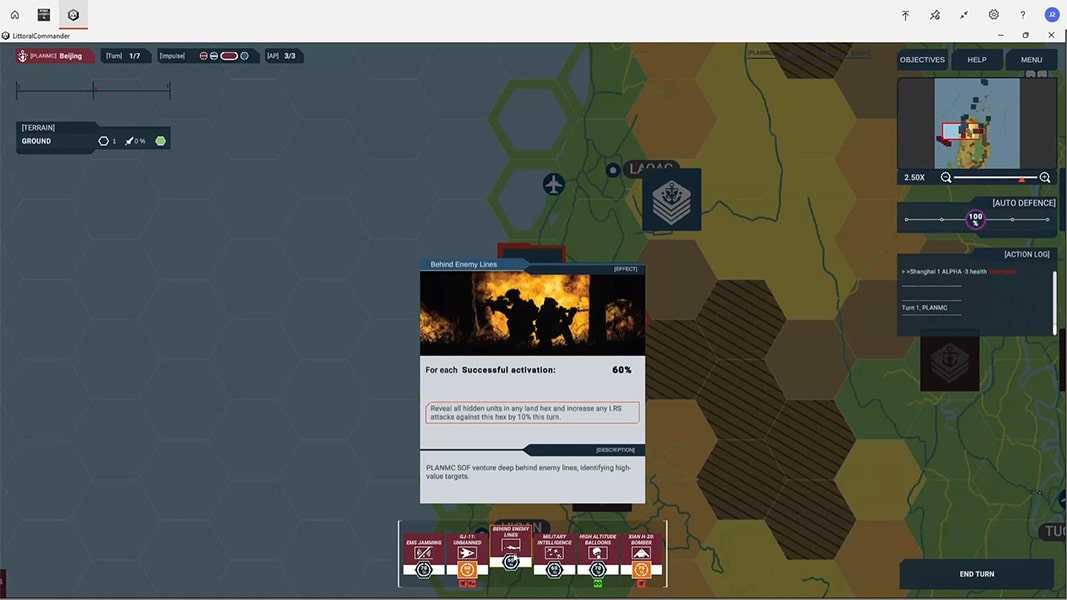
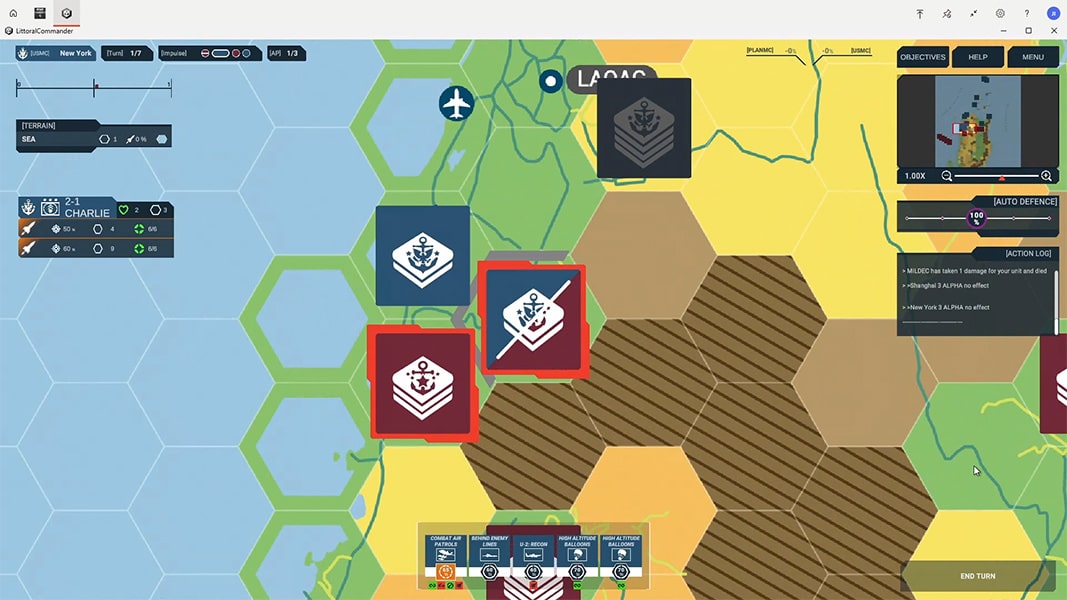
The game operates on an operational hex-map engine with scenarios depicting current and near-future contested operations in the South China Sea, Philippine Sea, and Taiwan Strait. US Marine Corps Littoral Combat Teams, naval surface groups, and allied joint force elements manoeuvre against PLANMC formations and peer adversary forces, each modelled with doctrinal behaviour and realistic A2/AD capability sets.
The impulse-based turn structure introduces operational tempo as a core mechanic action and reaction cycles that reward decisive joint force employment and punish hesitation, poor sequencing, or failure to integrate effects across domains. Planning must account for naval surface threats, air denial corridors, maritime chokepoints, and terrain spanning open water, island chains, coastline, and urban littoral zones. Human-versus-human Red/Blue play generates genuine decision friction and the irreducible fog of command that no AI opponent can fully replicate making it directly usable in CPX, TTX, and staff college syndicate formats.

Littoral Commander connects to the Hexwar Management System (HMS) and AAR analytics layer, providing faculty with visibility of every decision across the full operational cycle. The action log captures both Blue and Reddecision sequences, enabling systematic reconstruction of the campaign during structured debrief and facilitating the analytical interrogation that distinguishes rigorous PME from mere exercise activity.
The multiplayer capability supports Red/Blue CPX formats with distinct command roles across both chains of command, generating the inter-player decision friction that mirrors real staff dynamics. For Intermediate Command and Staff programmes (CGSC, ICSC(L)) and equivalent NATO staff college courses, this format directly replicates the command environment that course delegates are being prepared to operate in at their next appointment joint headquarters staff, operational level command, or multi-national task force.
Littoral Commander sits at the intersection of several high-priority PME requirements across the US, UK, and NATO educational frameworks: joint force integration and MDO application (CGSC Joint Module, ICSC(L) joint warfighting seminars, MCU electives); EABO and Force Design 2030 doctrine (MCU, MAWTS-1, Marine Corps Education Command); and Indo-Pacific theatre orientation for senior officers preparing for INDOPACOM-facing assignments or NATO Indo-Pacific engagement roles.
For the UK and NATO community, it directly supports instruction on amphibious and littoral operations relevant to the Royal Marines Littoral Response Group concept, 3 Commando Brigade planning, and NATO Standing Naval Force exercises. At a fraction of the cost and logistical overhead of a maritime CPX or joint exercise, it delivers a repeatable, analytically supported operational training environment that scales from individual directed study to full institutional syndicate play without specialist infrastructure, dedicated exercise control staff, or preparation time measured in weeks.



Develops operational-level joint thinking the core capability gap that CGSC, MCU, ICSC(L), and NATO staff colleges are mandated to address. Moves beyond platoon and company tactics into joint force sequencing and operational design.
Scenarios grounded in rigorous unclassified research on the two highest-priority near-future conflict theaters. Directly relevant to INDOPACOM, EUCOM, and NATO Baltic Enhanced Forward Presence operational planning.
Reflects USMC Force Design 2030, EABO, and DMO doctrine. Directly applicable to Littoral Combat Team training, MEF-level wargaming, and USMC and Royal Marines PME elective content.
Authentic USMC, USN, and allied force structures operating against PLANMC and peer adversary formations. Officers command real organisations in recognisable operational scenarios drawn from current contingency planning.
Adversary forces modelled with doctrinal behaviour and realistic A2/AD capability. Officers face an opponent that employs credible integrated fires, maritime denial, and air defence not a notional red cardboard force.
Human-vs-human play at the operational level generates irreducible decision friction and command uncertainty. Directly usable in CPX, TTX, and staff college syndicate formats without exercise control staff.
Commanders manage supply and support across distributed, contested positions operationally reinforcing that logistics drives reach and is a warfighting function. Directly aligned to sustainment doctrine in ADP 4-0 / JDP 4-00.
The game cannot be won through single-domain employment. Joint synchronisation is a mechanical requirement it is learned through execution, not briefed as a doctrinal concept. Mission failure is the consequence of getting it wrong.
Pre-built Indo-Pacific and Taiwan Strait scenarios for immediate deployment, with bespoke classified scenario development available for institutional partners requiring theatre-specific or operationally sensitive training environments.
Cloud or local network deployment without specialist hardware. Suitable for classroom, seminar, CPX, or individual directed learning. No IT support contract, no booking cycle, no logistical overhead.
Company Commander AI is the advanced “headless” edition of Hexwar’s flagship tactical PME platform…
Company Commander Cloud – integrated with HWS and optimized for Cloud Environments
Integrated into Tournament and Challenge Modes, Force Builder capable so players can construct their own force…